Project
Content discovery in Mural
Helping people find the right template based on what they’re trying to accomplish, not what they already know to search for.
Problem
Mural had a large library of useful templates, but finding the right one was often harder than it needed to be.
The library was organized largely around template names and methods, which worked well if you already knew what you were looking for. But many people came to Mural with a goal in mind rather than a specific method: planning a project, understanding a customer, running a workshop, or getting a team started.
We wanted to make template discovery feel more like answering “What are you trying to do?” than “Which template do you know the name of?”
Approach
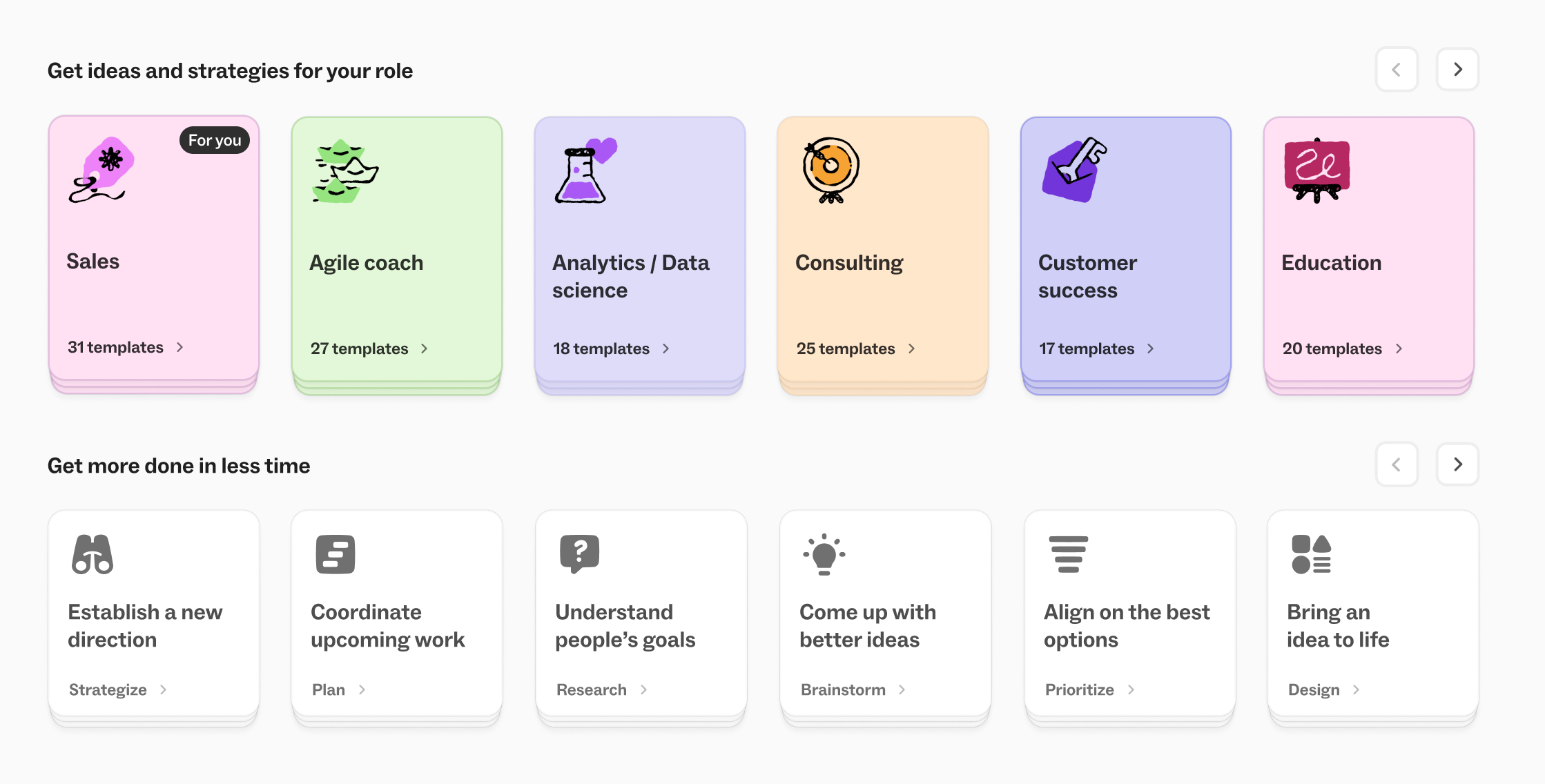
I worked with the team to rethink how people discovered templates, starting with role- and use-case-based pages on the Home tab.
Instead of showing a generic collection of templates, we organized them around the kinds of work people were trying to accomplish. We launched with eight roles and nine use cases, with the expectation that the system could evolve alongside Mural’s focus on different types of users.
From there, we worked on the broader discovery experience: making the template browser easier to scan, improving how templates were presented and previewed, and giving people better ways to understand what a template was before using it.
We treated each change as an experiment rather than assuming we knew what would work. The role and use-case experience was rolled out gradually so we could measure its effect on new-user behavior. We also tested a simpler template browser and later tested a clearer distinction between previewing a template and adding it to the canvas.
One of the most interesting results came from that last experiment. The winning design increased Day-1 retention by 10.64% and increased the number of new users who edited their canvas for at least ten minutes by 9.98%. At the same time, raw template usage went down by about 10%. That suggested that making the choice more explicit was reducing accidental template additions while leading to more meaningful use.
We also added recommendations for what to do next. For more than 80 templates, we created three suggested follow-on templates so that using one activity could naturally lead into another. I worked on both the product experience and the recommendation content.
Outcome
The role and use-case experience produced a statistically significant increase in Day-2 retention, with 27.4% of users in the experiment returning the next day compared with 24.6% in the control group. The experience was subsequently released to all users.
The redesigned template browser increased template usage by 5.94% across all users and by 9.21% among new users.
Together, these changes shifted template discovery from a library people had to figure out for themselves toward an experience that helped them start with their role, their goal, and the work they wanted to accomplish.